

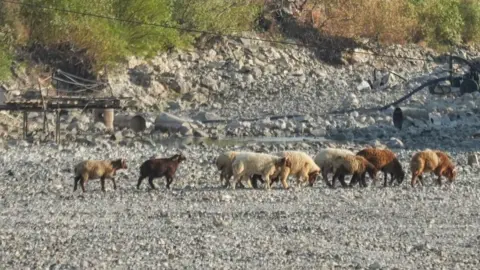
Outside a rural area by the city of Hama, farmland are expected to be golden and productive with crops.
Yet, Maher Haddad's land sits dry, yielding merely a fraction of its normal yield.
"Recently was catastrophic due to the water crisis," explained the 46-year-old cultivator.
The land yielded merely 190kg per dunum—significantly less than the typical amount achieved in a normal season.
"{We haven't recovered what we put in; we've suffered financially. It's impossible to finance next season's crops," he emphasized.
Having two young family members to feed, the farmer is relying on money from family to get by.
Countrywide Crisis
This hardship is echoed around Syria, where the gravest rain shortage in many years has cut crop yields by 40%.
A estimated deficit of 2.73 million tonnes is expected this season—equivalent to the annual dietary needs of millions of Syrians.

Growing Hunger
Without increased support or the ability to import grains, the crisis may deteriorate significantly.
Over 14,000,000 Syrians—around the majority of the public—presently find it hard to get sufficient food.
Out of these, 9.1 million experience serious food shortage, with a significant number in dire states.
Rainfall has decreased by nearly 70%, crippling three-quarters of dependent farmland.
"It represents the line between households staying in their homes or being forced to leave," commented an representative.
Household Struggles
Farming households are offloading herds to compensate for lost earnings, limiting their daily diet.
Hunger-related issues rates among minors and women are increasing.
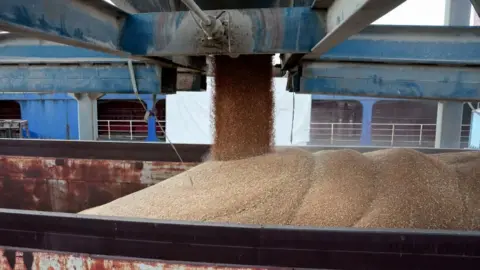
Wheat is a basic food in Syria, essential for loaves and noodles—low-cost items that are now rising in value.
For a widow aged thirty-nine, buying staples has become very hard.
Having several kids, she counts on her children' income, which are not daily costs.
"Occasionally we borrow funds just to afford food," she explained.
Previously, a portion of bread was priced at 500 money, but now it is four thousand five hundred.
For her household, it takes two units a day—a financial burden of 9,000 currency units, not including other necessities.
National and Global Response
This emergency creates a significant problem for the government, which is attempting to rebuild the nation after a long period of conflict.
Support organizations are providing food support for those most vulnerable, but officials warn that these are stopgap fixes.
"Efforts are underway to keep people in the farming field," stated a program director.
Financial payments have been distributed to small farmers who lost their entire harvest.
However, after over a decade of conflict, Syria's farming industry was already damaged by financial crisis, destroyed water systems, and contaminated land.
Resource Problem
In key agricultural regions, wheat fields must have numerous irrigation sessions per growing period, but because of lack of precipitation, the majority of farmers find it impossible to keep up.
"The agricultural worker's main concern is finding irrigation," stated a area official.
Water requires diesel, and expenses have increased significantly, hitting eleven thousand to 12,000 currency per gallon.
Expensive fuel costs and frequent interruptions have made irrigation systems out of reach for many farmers.
Sustainable Options
One goal for the authorities is funding water infrastructure—including renewable energy watering systems—to make resources more accessible.
But those plans need long-term investment and funding—options that growers cannot access at present.
Thus, for millions citizens around the country, there is simply one hope to rely on in the next months: hope for rain.

